
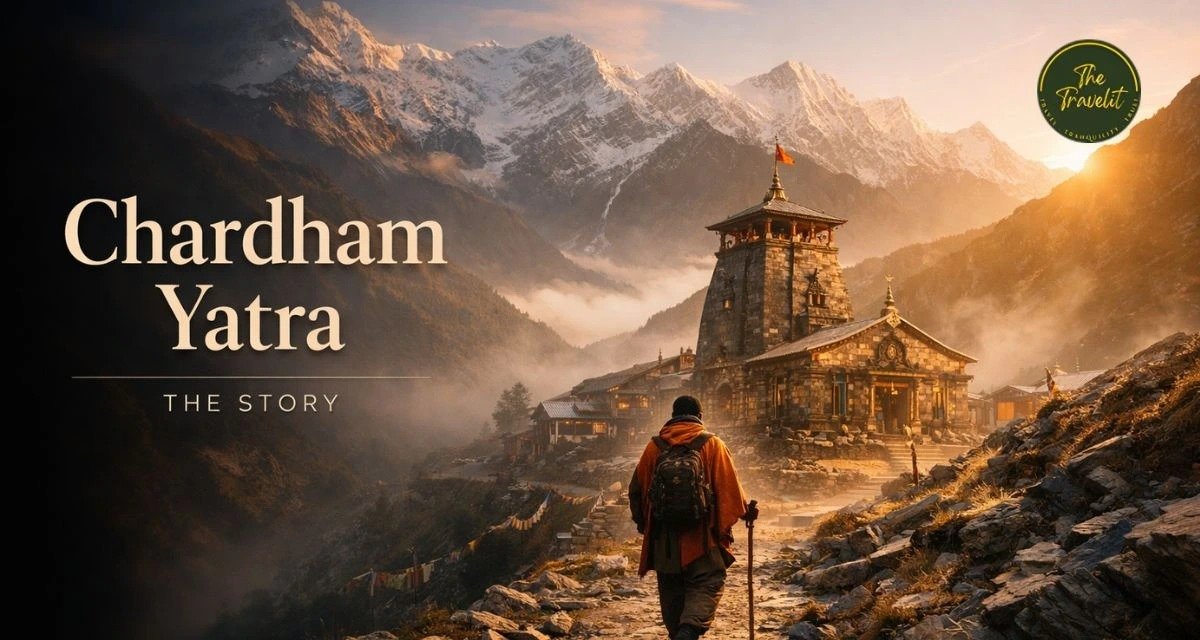
Char Dham Yatra – The Story
The Char Dham Yatra of Uttarakhand is not merely a pilgrimage, it is a journey that has been quietly shaping faith, endurance, and perspective for centuries. Long before it became accessible by roads and helicopters, it was a path carved by belief alone. Pilgrims would leave their homes with little more than faith in their hearts, walking into the vast, unpredictable Himalayas, not knowing what lay ahead. It was never about comfort; it was about surrender. Somewhere between the silence of the mountains and the roar of sacred rivers, people discovered something deeper than devotion, they discovered themselves.
The origins of this sacred circuit are closely tied to Adi Shankaracharya, the ancient philosopher who re-established Hindu spiritual traditions across India. He is believed to have formalized the Char Dham Yatra as a structured path of spiritual awakening, connecting four powerful shrines—Yamunotri Temple, Gangotri Temple, Kedarnath Temple, and Badrinath Temple. Each of these shrines represents not just a deity, but a force of nature and existence. Yamunotri marks the origin of the Yamuna, symbolizing life and vitality. Gangotri represents the descent of the Ganga, carrying the power of purification. Kedarnath, dedicated to Lord Shiva, stands as a symbol of destruction and transformation, while Badrinath, devoted to Lord Vishnu, represents preservation and balance. Together, they form a spiritual cycle—creation, purification, transformation, and salvation.
Historically, undertaking the Char Dham Yatra was considered an act of immense courage and devotion. The routes were treacherous, weather conditions unpredictable, and facilities almost non-existent. Pilgrims often relied on local villagers, basic shelters, and sheer willpower to complete the journey. It was believed that completing this yatra would cleanse one’s sins and guide the soul toward moksh, or liberation. But beyond religious belief, the journey demanded something rare, it required patience, humility, and acceptance. The mountains did not bend to human plans; instead, travelers had to align themselves with nature’s rhythm.
Over time, the importance of the Char Dham Yatra grew beyond individual spirituality and became deeply embedded in India’s cultural and emotional fabric. Families began undertaking the journey together, often as a once-in-a-lifetime experience. For many, it became a way to honor their parents, fulfill lifelong wishes, or seek blessings during important phases of life. The yatra evolved into a bridge between generations, where stories, traditions, and faith were passed down not through words alone, but through shared experience.
In the present day, the Char Dham Yatra has transformed significantly. Roads now reach close to the shrines, helicopter services operate regularly, and accommodations range from basic lodges to comfortable hotels. Government initiatives have improved connectivity and safety, making the journey accessible to a wider group of people, including the elderly. Yet, despite these developments, the essence of the yatra remains unchanged. The mountains still command respect, the weather still tests patience, and the journey still demands inner strength. Technology may have shortened the distance, but it has not reduced the depth of the experience.
At the same time, the modern scenario brings its own challenges. Increasing footfall has raised concerns about environmental impact, waste management, and the delicate balance of the Himalayan ecosystem. The devastating floods of 2013 near Kedarnath served as a powerful reminder that these sacred spaces are also fragile. Today, there is a growing awareness that the yatra must be undertaken responsibly, with respect not only for the divine, but also for nature itself.
What makes the Char Dham Yatra truly timeless is that it offers something different to every traveller. For some, it is an act of devotion. For others, it is a test of endurance. And for many, it becomes a journey of reflection, a rare pause in a fast-moving world. As one moves from the gentle beginnings at Yamunotri to the spiritual intensity of Kedarnath and finally to the calm completeness of Badrinath, the journey mirrors life itself, uncertain, challenging, and yet deeply meaningful.
In the end, the Char Dham Yatra is not about reaching four temples. It is about the transformation that happens along the way. The mountains do not change, the temples do not change—but the person who returns often does.